

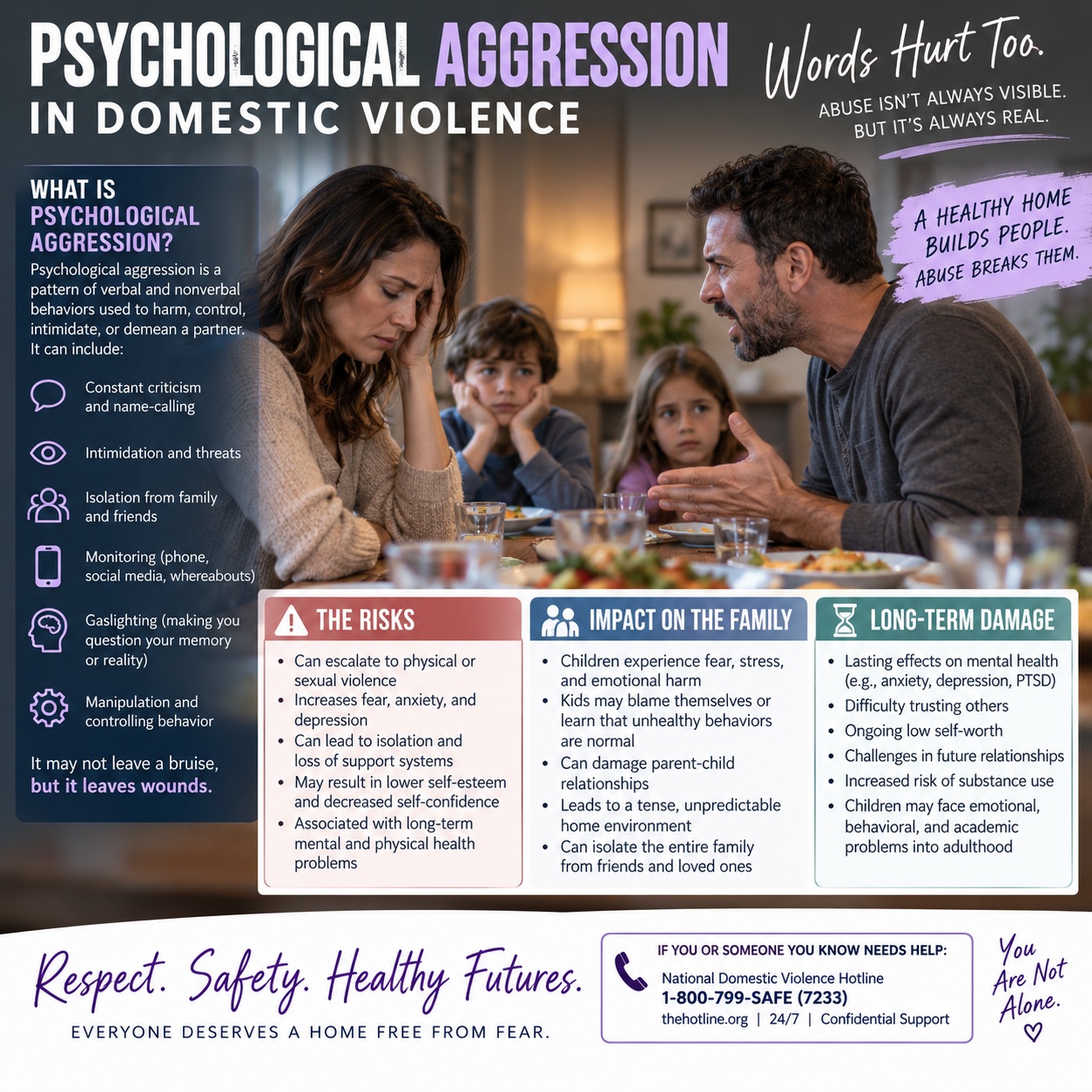
Psychological Aggression in Domestic Violence: The Abuse You May Not Be Able to See
Psychological Aggression in Domestic Violence: The Abuse You May Not Be Able to See
There may be no bruise.
No broken bone.
No photograph of an injury.
No obvious evidence that something is terribly wrong.
Instead, there may be a person sitting quietly at dinner, carefully choosing every word because they know saying the wrong thing could start an argument.
There may be someone who no longer sees friends because every visit results in accusations when they get home.
Someone who apologizes constantly.
Someone who has begun questioning their own memory.
Someone who used to be confident but now wonders whether they can make even the simplest decision correctly.
This is one of the reasons psychological aggression can be so difficult to recognize—and so damaging.
The CDC defines psychological aggression in intimate partner violence as verbal or nonverbal communication intended to harm a partner mentally or emotionally or to exert control over them. It can include humiliation and name-calling, coercive control, threats, monitoring, gaslighting, isolation, and other behaviors.
It may not leave a visible injury.
But that doesn’t mean it leaves no injury at all.
It Often Starts With Things That Are Easy to Explain Away
Psychological aggression doesn’t necessarily begin with screaming or threats.
Sometimes it begins with comments that can almost sound like concern.
“I don’t like your friends. They’re a bad influence on you.”
“Why do you need to go out without me?”
“Give me your password. If you have nothing to hide, what’s the problem?”
“I’m only telling you this because I love you.”
A partner’s jealousy may initially be interpreted as affection.
Constant texting may seem like attentiveness.
Wanting to spend every moment together may feel romantic.
Criticism may be disguised as helpful advice.
Then, gradually, the boundaries move.
The questions become interrogations.
The suggestions become rules.
The teasing becomes humiliation.
The jealousy becomes monitoring.
And the person on the receiving end begins changing their behavior to keep the peace.
What Does Psychological Aggression Look Like?
It can take many forms.
It may be constant criticism and humiliation—calling a partner stupid, unattractive, worthless, incompetent, or a bad parent.
It may involve deliberately embarrassing them in front of friends or family.
It can be intimidation: screaming, punching a wall, breaking something, driving dangerously during an argument, or behaving in a way that communicates, Look what I’m capable of.
It can involve threats.
“If you leave me, you’ll regret it.”
“I’ll make sure you never see the children.”
“Nobody is going to believe you.”
It can mean monitoring someone’s whereabouts, communications, friendships, spending, or online activity.
And it can involve gaslighting—deliberately causing someone to question their own memory or perception of what happened. The CDC includes gaslighting among forms of psychological aggression.
The National Domestic Violence Hotline similarly describes emotional abuse as nonphysical behavior used to control, isolate, or frighten someone, including threats, insults, excessive monitoring, manipulation, humiliation and intimidation.
“You’re Too Sensitive.”
Psychological aggression can become especially confusing when the person causing the harm continually denies that anything harmful happened.
“You’re overreacting.”
“I was joking.”
“I never said that.”
“You’re imagining things.”
“Why do you always make me the bad guy?”
“You’re crazy.”
After hearing messages like these repeatedly, a person may begin wondering whether the problem really is them.
They replay conversations in their head.
“Maybe I misunderstood.”
“Maybe I shouldn’t have said anything.”
“Maybe I really am too sensitive.”
Eventually, they may stop trusting their own judgment.
And once someone no longer trusts themselves, controlling them can become much easier.
Walking on Eggshells
One of the clearest signs of psychological harm may be what happens to the victim’s everyday behavior.
They begin monitoring the other person’s mood.
How did they close the front door?
What tone did they use when they said hello?
Are they drinking tonight?
Are they angry?
Should I mention the credit-card bill?
Maybe this isn’t a good time to tell them I talked to my sister.
The victim becomes extraordinarily good at reading the room.
They may change clothes, cancel plans, avoid subjects, hide harmless purchases, keep children quiet, or agree with things they don’t actually agree with.
From the outside, the home may appear peaceful.
Inside, everyone may be working very hard to prevent an explosion.
That isn’t peace.
It’s fear managing the household.
The Risk of Escalation
Psychological aggression should not be dismissed simply because physical violence hasn’t occurred.
CDC guidance notes that psychological aggression frequently occurs alongside other forms of intimate partner violence, and research cited by the agency indicates that it can precede physical or sexual violence in violent relationships. That does not mean every psychologically abusive relationship will become physically violent, but it is one reason threatening and controlling behavior deserves to be taken seriously.
Certain behaviors can also carry very different meanings depending on context.
A raised voice during an argument is not automatically domestic abuse.
Neither is every insensitive remark or disagreement.
Relationships sometimes include conflict, anger, and mistakes.
The concern is the pattern, purpose, context, and impact: Is one person repeatedly using fear, degradation, manipulation, threats, isolation, surveillance, or control to dominate the other?
That’s very different from two people having a bad argument.
What Happens to Someone Who Lives This Way for Years?
Imagine being told repeatedly that you’re worthless.
Eventually, part of you may start believing it.
Imagine having every decision criticized.
Eventually, making decisions can become frightening.
Imagine being accused every time you see friends.
Eventually, staying home seems easier.
Imagine being told nobody else would want you.
Eventually, leaving may seem impossible.
Psychological abuse can gradually change the way someone sees themselves.
The person who once walked confidently into a room may begin second-guessing everything.
The National Domestic Violence Hotline notes that emotional abuse can erode self-worth and confidence and create psychological dependence on an abusive partner.
The Mental and Physical Toll
Living in an environment of fear and control can affect much more than someone’s mood.
Intimate partner violence is associated with depression and post-traumatic stress symptoms, as well as chronic health consequences. Relationship violence can also be associated with sleep problems, anxiety, difficulty trusting others and problematic substance use.
A person may struggle to concentrate at work.
They may become exhausted.
They may withdraw socially.
They may experience headaches, stomach problems or disrupted sleep.
They may feel anxious even when nothing appears to be happening.
That’s an important point.
After living with unpredictable aggression for a long time, the absence of an argument doesn’t necessarily feel safe.
The person may still be waiting for the next one.
Children Hear More Than Adults Think They Do
Sometimes parents believe:
“We never argue in front of the children.”
But children don’t need to witness every incident to understand that something is wrong.
They notice when Mom suddenly becomes quiet when Dad enters the room.
They hear conversations through walls.
They notice insults.
They see one parent being humiliated.
They recognize when everyone changes their behavior depending on someone’s mood.
They notice when a parent isn’t allowed to see certain people.
They may even begin participating in the family’s attempt to keep the abusive person calm.
“Don’t tell Dad.”
“Mom’s upset, so be quiet.”
“Maybe we shouldn’t ask right now.”
A child can learn remarkably early how to walk on eggshells.
Government health resources warn that children exposed to domestic violence can experience fear and anxiety and face increased risks for longer-term mental and physical health problems.
Children May Blame Themselves
Children naturally try to make sense of what happens around them.
Sometimes they reach the wrong conclusion.
“Dad was yelling because I was being too loud.”
“Mom was crying after they argued about me.”
“If I behaved better, maybe they wouldn’t fight.”
A child may begin believing that keeping the family together—or keeping everyone calm—is somehow their responsibility.
That’s an enormous emotional burden for a child.
Children need to hear clearly:
“This is an adult problem. You didn’t cause it, and it isn’t your job to fix it.”
Children Can Learn the Wrong Lessons About Love
Children learn relationships partly by watching relationships.
If a child repeatedly sees love mixed with humiliation, fear, control, jealousy, threats, or intimidation, those behaviors can begin to seem normal.
They may learn:
Jealousy means love.
One person gets to control the other.
Yelling is how adults solve problems.
Keeping secrets protects the family.
Love means constantly proving your loyalty.
Fear is simply part of being in a relationship.
Exposure doesn’t determine a child’s future, and many children who grow up around domestic violence go on to build healthy, respectful relationships.
But exposure to violence and abuse in childhood is associated with meaningful long-term risks, which is why early support matters.
Psychological Aggression Can Divide an Entire Family
Abuse rarely stays neatly contained between two adults.
An abusive partner may undermine the other parent in front of the children.
“Your mother doesn’t know what she’s doing.”
“Your father doesn’t care about this family.”
Children may be encouraged to take sides.
One parent may use the children to gather information about the other.
Extended family relationships can deteriorate because the victim becomes increasingly isolated.
Friends stop calling because invitations are repeatedly declined.
Grandparents see the children less often.
Eventually, an entire support system can begin disappearing.
That isolation can make the victim even more dependent on the person controlling them.
The Damage Can Continue After the Relationship Ends
Leaving an abusive relationship doesn’t necessarily switch off its psychological effects.
Someone may be physically safe and still find themselves apologizing constantly.
They may struggle to make decisions.
They may distrust compliments.
A raised voice may make their heart race.
They may have difficulty trusting a new partner.
They may interpret ordinary disagreements as warning signs because disagreement used to lead to humiliation or intimidation.
They may continue hearing the abusive person’s voice internally:
“You’re stupid.”
“Nobody wants you.”
“You can’t survive without me.”
Recovery can involve learning to recognize that those messages were not objective truths.
They were part of the abuse.
Why Doesn’t Someone Just Leave?
This question misunderstands how psychological control works.
By the time an outsider asks why someone hasn’t left, that person may have spent years being told they are incapable of surviving alone.
They may be financially dependent.
They may be isolated from family.
They may fear losing their children.
They may have been threatened.
They may still love their partner.
They may hope the person will change.
And leaving can itself be a period that requires careful safety planning.
Instead of asking:
“Why are you staying?”
A more useful question may be:
“What is making it difficult or unsafe for you to leave, and how can I support you?”
What Healthy Conflict Looks Like
Healthy relationships aren’t relationships without arguments.
Two people can disagree strongly.
They can become frustrated.
They can need space.
They can make mistakes.
But healthy conflict leaves room for both people to remain people.
You can disagree without being afraid.
You can have friends.
You can have opinions.
You can say no.
You can ask questions.
You can make mistakes without being humiliated.
You don’t have to monitor every sentence before speaking.
Love should not require someone to become smaller so that another person can feel bigger.
If Someone Tells You This Is Happening
Listen before trying to solve everything.
Don’t say:
“Why do you let them talk to you like that?”
“I would never put up with that.”
“Just leave.”
Those statements can unintentionally add another layer of judgment to someone who may already have been criticized for years.
Instead:
“I believe you.”
“That doesn’t sound okay.”
“You deserve to be treated with respect.”
“Are you feeling safe?”
“How can I help?”
If leaving or confronting the abusive person could increase danger, professional safety planning can be important.
Abuse Doesn’t Need to Leave a Bruise to Matter
Perhaps this is the message we need to understand most.
A person doesn’t need a black eye to be frightened in their own home.
A child doesn’t need to be physically struck to be affected by living in an atmosphere of intimidation.
And a relationship doesn’t have to become physically violent before someone is allowed to say:
“This is hurting me.”
Psychological aggression can affect confidence, mental health, relationships, parenting, work, physical well-being and a person’s fundamental sense of safety.
Its effects can spread through an entire family.
And some of those effects can remain long after the relationship itself has ended.
The absence of physical injury is not the same thing as the absence of harm.
If you or someone you know is experiencing psychological aggression, coercive control, threats, intimidation or other forms of domestic violence, confidential support is available through the National Domestic Violence Hotline at 1-800-799-SAFE (7233). The Hotline also offers confidential online support.
If there is immediate danger, contact emergency services.
For this post, I think a powerful image would be a family at a dinner table where nothing physically violent is occurring, but the tension is unmistakable—one parent speaking aggressively toward the other, the other adult withdrawn and visibly uncomfortable, while the children sit quietly and watch. It would illustrate the central point of the article: psychological aggression can affect everyone in a home even when no one is being physically struck