

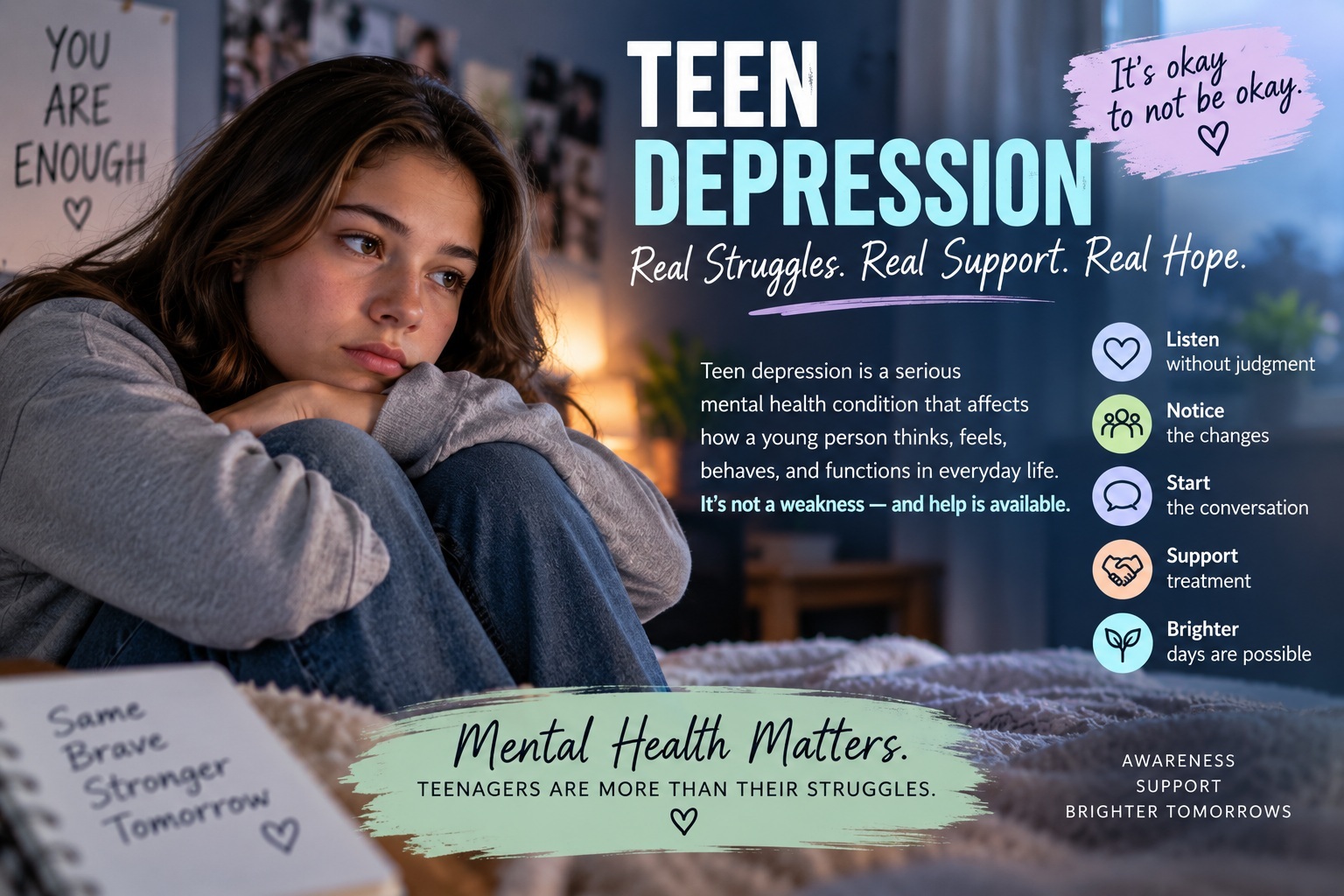
Teen Depression: When It’s More Than a Difficult Teenage Day
Teen Depression: When It’s More Than a Difficult Teenage Day
Being a teenager has never been simple.
There are friendships to navigate, pressure to fit in, academic expectations, changing bodies, social media, relationships, questions about the future, and the complicated process of figuring out who you are. With so much happening at once, emotional ups and downs are a normal part of adolescence.
A teenager may come home angry after a bad day, spend a weekend in their room after an argument with a friend, become overwhelmed by schoolwork, or feel devastated by a breakup.
But sometimes the sadness doesn’t lift.
The irritability doesn’t go away.
The teenager who once laughed easily becomes increasingly withdrawn. The student who cared about school stops turning in assignments. The athlete who couldn’t wait for practice suddenly doesn’t want to go. A teen who was always surrounded by friends begins spending most of their time alone.
At that point, we may be dealing with something very different from ordinary teenage growing pains.
Teen depression is a serious mental health condition that affects how a young person thinks, feels, behaves, and functions in everyday life.
And it deserves to be taken seriously.
Depression Isn’t a Weakness
One of the most important things parents—and teenagers themselves—need to understand is that depression isn’t a character flaw.
A depressed teenager isn’t necessarily lazy, ungrateful, dramatic, attention-seeking, or simply refusing to look at the bright side.
According to the Mayo Clinic, teen depression can cause persistent sadness and a loss of interest in activities while creating emotional, functional, and even physical problems.
It isn’t something a teenager can simply “snap out of” through willpower.
The encouraging part is that depression is treatable. For many teenagers, symptoms improve with appropriate treatment, which may include psychological counseling, medication, or a combination determined with a healthcare professional.
Teen Depression Doesn’t Always Look Like Sadness
This is where depression in teenagers can become particularly easy to miss.
We tend to picture depression as someone who looks visibly sad and cries frequently. That can certainly happen.
But a depressed teenager may look angry rather than sad.
They may become irritable over things that once wouldn’t have bothered them. Small disappointments can trigger surprisingly intense reactions.
You may hear:
“Leave me alone.”
“What’s the point?”
“Nobody understands.”
“I don’t care anymore.”
“Nothing matters.”
A teenager who appears angry, difficult, defiant, or unusually sensitive may actually be struggling emotionally.
That doesn’t mean every angry teenager is depressed. But a significant change from a teenager’s usual personality and behavior deserves attention.
Sometimes You Notice What Has Disappeared
Depression isn’t only about the appearance of new symptoms.
Sometimes it’s about the disappearance of things that used to matter.
A teenager loved basketball.
Now the basketball sits in the garage.
They couldn’t wait to see their friends.
Now every invitation gets declined.
They loved drawing, music, gaming, dance, working on cars, hiking, or spending time with family.
Now the answer is always:
“I don’t feel like it.”
Loss of interest or pleasure in activities that were previously meaningful can be an important warning sign of depression.
Parents may initially interpret this as laziness or boredom.
It may be neither.
Watch for Emotional Changes
Depression can change a teenager’s internal world in ways that aren’t immediately obvious to everyone around them.
A teen may experience persistent sadness, hopelessness, emptiness, irritability, frustration, guilt, or feelings of worthlessness.
Their self-esteem may fall dramatically.
A minor mistake can become evidence that they are a failure.
A disappointing grade becomes:
“I’m stupid.”
A friendship problem becomes:
“Nobody likes me.”
A breakup becomes:
“Nobody will ever love me.”
One mistake becomes:
“I ruin everything.”
The Mayo Clinic also identifies excessive self-criticism, fixation on past failures, extreme sensitivity to rejection, difficulty concentrating and making decisions, and a bleak view of life and the future among possible symptoms.
That last one deserves particular attention.
Depression can distort the way a young person sees tomorrow.
A problem that adults recognize as temporary may feel permanent to a teenager who is depressed.
They may have difficulty imagining that life could ever feel different from the way it feels right now.
Behavior Can Tell Us What Words Don’t
Teenagers don’t always say, “I think I’m depressed.”
Sometimes their behavior communicates what they can’t explain.
A teenager may suddenly start sleeping constantly—or barely sleeping at all.
Their appetite may change significantly.
They may seem exhausted regardless of how much they sleep.
Grades can fall.
School absences may increase.
Personal hygiene or appearance may receive less attention.
They may isolate themselves from friends and family.
Some teenagers become restless or agitated. Others seem physically and mentally slowed down.
Depression can even appear as physical complaints. A teenager may repeatedly complain about headaches, stomachaches, or other unexplained aches and pains.
And some teenagers may begin using alcohol or drugs, engaging in risky behavior, having angry outbursts, or acting out in ways that seem completely unlike them.
Instead of only asking, “Why is my teenager behaving this way?” it can sometimes help to ask, “What might my teenager be experiencing that is causing this behavior?”
When School Starts Falling Apart
School is often one of the first places depression becomes visible.
Imagine trying to complete an algebra test when your mind is filled with hopeless thoughts.
Or trying to remember a history assignment when you’re exhausted from barely sleeping.
Or trying to sit through seven classes when simply getting out of bed required nearly all the energy you had.
Depression can affect concentration, memory, motivation, energy, and decision-making.
A previously successful student may suddenly struggle academically.
Assignments aren’t completed.
Deadlines are missed.
Absences increase.
Teachers may interpret the change as lack of effort.
Parents may respond by increasing pressure.
The teenager may already believe they’re failing.
That can create a painful cycle:
Depression makes school harder.
School problems create additional stress.
Additional stress worsens feelings of failure and hopelessness.
Recognizing what is happening can change the conversation from punishment to support.
The Bedroom Door Closes
Nearly every teenager wants some privacy and independence.
Spending more time away from parents is part of adolescence.
But there is a difference between healthy independence and progressive isolation.
A teen stops eating dinner with the family.
Then they stop seeing friends.
Then they quit activities.
Eventually, most of their life happens behind a closed bedroom door.
Again, no single behavior proves that a teenager has depression.
The important question is:
Has something meaningfully changed?
Parents know their children. A major departure from a teen’s previous personality, routines, interests, friendships, school performance, or behavior is worth noticing.
Peer Pressure and Rejection Can Feel Enormous
Adults sometimes forget how intense the teenage social world can be.
A friendship ending, exclusion from a group, bullying, rejection by someone they like, embarrassment at school, or something posted online may seem manageable from an adult perspective.
For a teenager, it can feel overwhelming.
Teenagers with depression may also become extremely sensitive to rejection or failure and seek repeated reassurance.
That’s why responses such as:
“You’ll get over it.”
“That’s nothing compared with real life.”
“You’re being dramatic.”
can unintentionally shut down the conversation.
We don’t have to agree that the situation is catastrophic to recognize that the teenager’s emotional pain is real.
What’s Normal—and What’s Not?
This may be one of the hardest questions for parents.
Teenagers are supposed to have moods.
They’re supposed to become more independent.
They’re going to argue with parents sometimes.
They may change friendships, clothing, music, interests, and opinions seemingly overnight.
So where is the line?
There isn’t one single symptom that provides the answer.
Instead, look at duration, intensity, change, and impairment.
Is this significantly different from your teenager’s usual behavior?
Has it continued rather than passing?
Is it interfering with school, friendships, family relationships, sleep, eating, activities, or everyday functioning?
Does your teenager seem able to manage difficult emotions, or does life increasingly seem overwhelming?
When you’re concerned, you don’t need to wait until you’re certain it’s depression before asking for help.
Start the Conversation
Talking about depression doesn’t require the perfect opening line.
You might simply say:
“I’ve noticed you haven’t seemed like yourself lately, and I’m worried about you.”
Or:
“You don’t have to tell me everything right now. I just want you to know I’m here, and I want to understand what you’re going through.”
Then listen.
Try not to immediately correct, lecture, compare, or solve.
If your teenager says:
“Everything is terrible.”
the first response doesn’t have to be:
“No it isn’t.”
You can start with:
“It sounds like things feel pretty terrible right now. Tell me what’s been going on.”
That keeps the door open.
When Professional Help Is Needed
If symptoms continue, interfere with everyday life, or make you concerned about your teenager’s safety, the Mayo Clinic recommends talking with a doctor or mental health professional experienced in working with adolescents.
A family physician or pediatrician can be a good starting point. School professionals may also be able to help families connect with appropriate resources.
Don’t assume significant depression will simply disappear on its own.
Treatment can make an enormous difference.
And getting help doesn’t mean a parent failed.
It means a young person is experiencing a health problem that deserves care.
Take Self-Harm Seriously
Some teenagers experiencing depression may intentionally hurt themselves, including through cutting or burning.
Self-harm should never be dismissed as “attention-seeking.”
Whatever its motivation, a teenager deliberately injuring themselves is communicating significant distress and needs professional attention.
Parents should respond with concern rather than shame or punishment.
And then there is one warning sign that requires particular attention:
Thoughts or statements about death or suicide.
Never Ignore Talk About Suicide
A teenager doesn’t have to say:
“I’m going to kill myself.”
Listen for other statements, too.
“Everyone would be better off without me.”
“I wish I could disappear.”
“There’s no reason for me to be here.”
“I can’t do this anymore.”
“I wish I could go to sleep and never wake up.”
The Mayo Clinic advises taking concerns about suicide seriously even when other depression symptoms don’t appear severe.
Never assume a teenager is simply being dramatic or trying to get attention.
If a young person tells you they are thinking about suicide, that conversation deserves immediate attention.
If there is an immediate danger or a suicide attempt has occurred, call 911 or your local emergency number, stay with the person, and seek emergency medical help.
In the United States, anyone experiencing suicidal thoughts or a mental health crisis can call or text 988 to reach the 988 Suicide & Crisis Lifeline, which is available 24 hours a day.
Teenagers: You Can Ask for Help Too
If you’re a teenager reading this and some of this sounds familiar, you don’t have to figure out whether your feelings are “bad enough” before talking to someone.
Tell somebody.
A parent.
A doctor.
A school nurse.
A teacher.
A counselor.
A coach.
A relative.
A trusted adult.
And if the first person doesn’t understand how serious things feel, tell someone else.
Asking for help isn’t admitting defeat.
It’s giving someone the opportunity to help you carry something that has become too heavy to carry alone.
Pay Attention to the Teenager Behind the Behavior
A teenager who suddenly stops caring may actually care very deeply and feel overwhelmed.
The angry teenager may be hurting.
The exhausted teenager may not simply be lazy.
The student whose grades suddenly collapse may be struggling to concentrate.
The teenager who spends every evening alone may not actually want to feel alone.
And the teenager who says, “I’m fine,” may not know how to explain what they’re feeling.
Teen depression can be serious.
But serious does not mean hopeless.
With recognition, compassionate support, professional care, and appropriate treatment, many teenagers with depression can improve.
Sometimes the most important first step is remarkably simple:
Notice the change.
Ask the question.
Listen to the answer.
And when a teenager is struggling, take them seriously.