

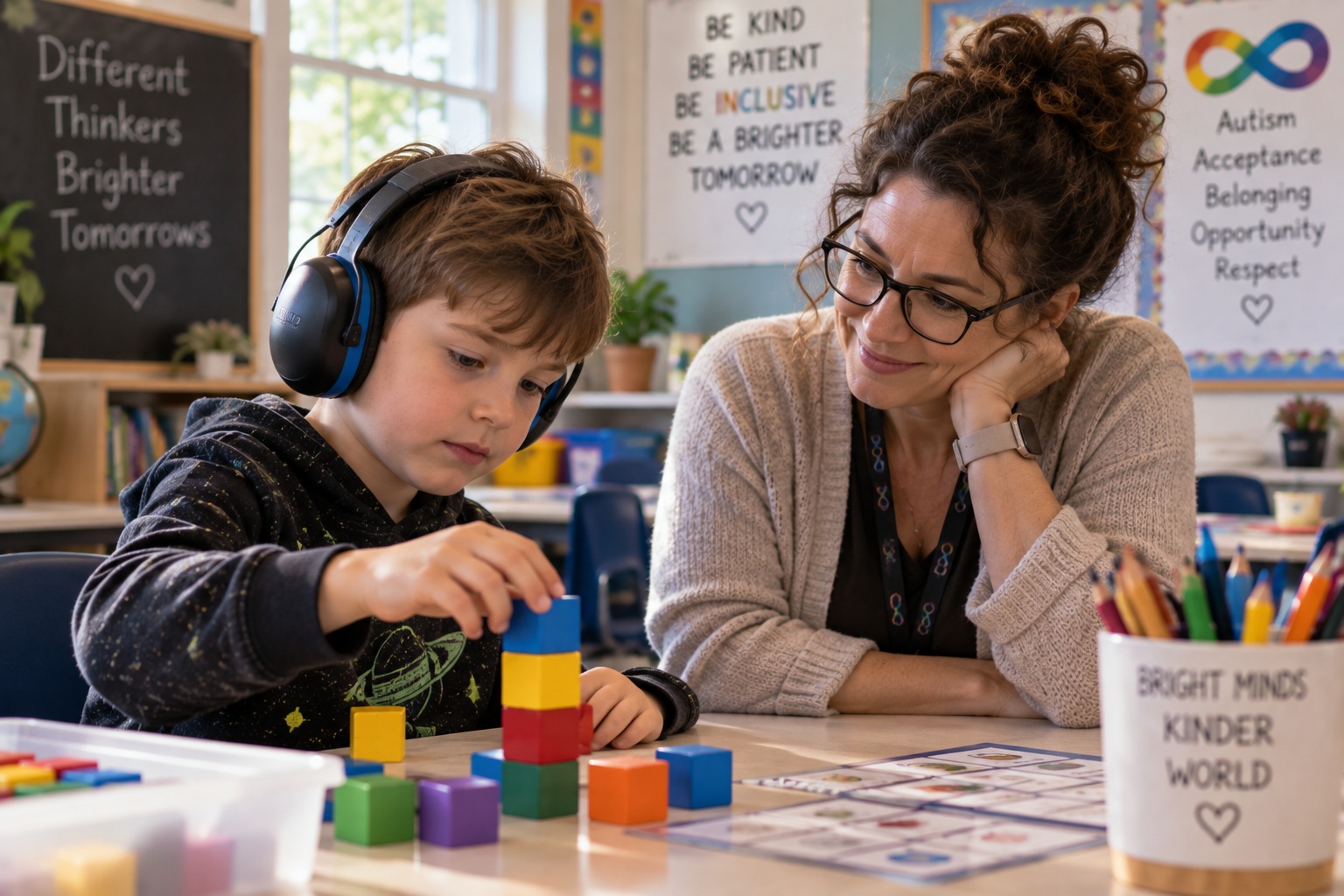
Understanding Autism in Children: Seeing the Child Behind the Behavior
Understanding Autism in Children: Seeing the Child Behind the Behavior
Every child develops a little differently.
One child may start talking early but take longer to become comfortable playing with other children. Another may be quiet, intensely observant, and happiest following familiar routines. Some children love noisy birthday parties and crowded playgrounds. Others find those same environments completely overwhelming.
Differences are a normal part of childhood.
But sometimes a child’s differences in communication, social interaction, behavior, sensory processing, and flexibility form a pattern that may indicate Autism Spectrum Disorder, or ASD.
For parents, hearing the word autism for the first time can bring a flood of questions.
What does this mean for my child? Will they talk? Will they make friends? Will they go to a regular school? Will they be independent someday?
Those questions are understandable. But autism is a spectrum, and no diagnosis can predict a child’s entire future.
The best place to begin is much simpler:
Understand the child who is in front of you today.
What Is Autism in Children?
Autism is a developmental condition. This means its characteristics begin during early development, although they may not always be recognized right away.
Autism primarily involves differences in two broad areas: social communication and interaction, and restricted or repetitive patterns of behavior, interests, or activities.
That clinical description can sound complicated.
In everyday childhood, it may look like a child who communicates differently, plays differently, reacts strongly to certain sensations, becomes distressed by unexpected changes, or develops an unusually intense interest in a particular subject.
But autism doesn’t look the same in every child.
One autistic child may speak very little. Another may have an enormous vocabulary and talk at length about subjects that fascinate them.
One may actively seek affection. Another may be uncomfortable with unexpected physical contact.
One child may have an intellectual disability. Another may be academically advanced.
Knowing one autistic child doesn’t mean you know what autism will look like in another.
What Are Some Early Signs?
Parents are often the first people to sense that something is different.
Sometimes it’s difficult to explain. A parent may simply say, “He doesn’t seem to interact the way his brother did at this age,” or “She talks, but conversations with her feel different.”
Possible signs can involve communication and social interaction.
A child may respond inconsistently to their name, use fewer gestures, have difficulty with back-and-forth interaction, or seem less interested in sharing experiences with other people.
Some children have delayed spoken language. Others speak on schedule—or even early—but use language differently.
They may repeat words or phrases they’ve heard, speak extensively about a favorite subject, or have difficulty recognizing when another person wants to change the conversation.
Eye contact may also be different, although lack of eye contact alone does not mean a child has autism.
Play Can Give Us Clues
Watch children playing and you’ll see an incredible amount of development happening.
They’re practicing communication, imagination, cooperation, negotiation, and social rules without even realizing it.
An autistic child’s play may look different.
A child might repeatedly line up toy cars rather than creating an imaginary story with them. They may become fascinated with the wheels instead of the entire car.
Another child might play imaginatively but insist that the game happen exactly the same way every time.
Some autistic children prefer playing alone. Others desperately want friends but aren’t sure how to join a group or keep an interaction going.
That’s an important distinction.
Difficulty with social interaction doesn’t necessarily mean a child doesn’t want social connection.
Sometimes they simply need help navigating it.
Why Are Routines So Important?
Imagine waking up tomorrow and discovering that all the rules of your day have unexpectedly changed.
Your morning routine is different. Your workplace has moved. Everyone expects you to know what’s happening, but nobody has explained it.
You might feel anxious too.
For some autistic children, predictability creates a sense of safety.
They may want the same breakfast, the same route to school, the same bedtime routine, or the same seat at the table.
A small change that seems insignificant to an adult can feel enormous to the child.
That doesn’t mean families should never change routines.
Instead, it can help to prepare children for changes whenever possible.
“We usually go straight home after school, but today we’re stopping at the grocery store first.”
A little warning can sometimes make a big difference.
The World May Feel Different to Their Senses
This is one of the most important things for adults to understand.
Autistic children may experience sensory information differently.
Sounds that barely register for you may feel painfully loud to them.
The hand dryer in a public restroom. A school bell. A vacuum cleaner. A crowded cafeteria. People singing “Happy Birthday.”
A child may cover their ears, run away, cry, or become extremely distressed.
Other sensations can be equally difficult.
A tag inside a shirt may feel unbearable. Certain food textures may trigger a strong reaction. Fluorescent lights may be overwhelming. Haircuts, toothbrushing, or crowded stores can become major challenges.
Other children seek additional sensory input. They may spin, jump, rock, touch objects, or enjoy pressure and movement.
When we understand sensory differences, we can begin asking a better question.
Instead of “Why is this child behaving this way?”
ask:
“What might this child be experiencing right now?”
Understanding Repetitive Behaviors
Some autistic children rock, flap their hands, pace, repeat sounds, spin objects, or make other repetitive movements.
These behaviors are sometimes called stimming, short for self-stimulatory behavior.
To someone unfamiliar with autism, the behavior may look unusual.
But it can serve a purpose.
A child might stim when excited, anxious, overwhelmed, or trying to regulate themselves.
If a repetitive behavior isn’t dangerous or preventing the child from participating in important activities, adults should consider what function it serves before automatically trying to stop it.
Sometimes what looks unusual to us is helping the child cope.
A Meltdown Isn’t Simply a Tantrum
This distinction can completely change the way an adult responds.
A tantrum often involves a child wanting something and becoming upset when they don’t get it.
An autistic meltdown can occur when the child’s ability to cope has been overwhelmed.
Too much noise.
Too many people.
An unexpected change.
Difficulty communicating.
Exhaustion.
Frustration.
Several small stresses piling up throughout the day.
Eventually, the child’s system reaches its limit.
During a meltdown, reasoning, lecturing, or punishment may make things worse.
The immediate priorities are safety, reducing stimulation, remaining calm, and allowing the child time to recover.
Later, when everyone is calm, adults can look for what may have triggered the overload and consider ways to reduce or manage it next time.
Some children respond to overwhelm by becoming very quiet or withdrawn instead. This is sometimes described as a shutdown.
Communication Is More Than Speech
We naturally place enormous importance on spoken language.
But speaking and communicating aren’t exactly the same thing.
Some autistic children speak fluently. Some develop speech later. Some use relatively few spoken words.
Children who have difficulty with speech may communicate through gestures, pictures, communication boards, or augmentative and alternative communication (AAC) devices.
These aren’t lesser forms of communication.
The goal is communication—not forcing every child to communicate in exactly the same way.
And a child who cannot easily express something verbally may understand considerably more than adults assume.
Autism Can Be Easier to Miss in Some Children
Not every autistic child fits the stereotype people expect.
This is particularly relevant for some girls.
A girl may watch other children carefully and copy how they behave. She might rehearse conversations or imitate facial expressions and social behaviors.
She may appear to manage school successfully but come home emotionally and physically exhausted.
This is often called masking or camouflaging.
Children who mask effectively can sometimes go for years without anyone recognizing how much effort they’re putting into navigating everyday situations.
What About School?
School can be wonderful for an autistic child—and incredibly demanding.
Think about everything a school day involves beyond academics.
Crowded hallways. Bells. Fluorescent lights. Changing classrooms. Group assignments. Lunchtime noise. Social rules. Unexpected schedule changes. Sitting still. Following multiple instructions. Understanding what teachers mean even when they don’t say it directly.
A child may be academically capable while struggling with everything surrounding the academics.
The right supports depend on the individual child.
Some may benefit from visual schedules, written instructions, sensory breaks, additional transition time, a quieter testing environment, communication support, occupational therapy, or individualized educational services.
Support isn’t about making school easier. It’s about removing unnecessary barriers to learning.
What Can Parents Do at Home?
Start with observation.
When does your child seem happiest?
What situations consistently create distress?
What helps them calm down?
How do they communicate when they’re tired, hungry, frightened, or overwhelmed?
What interests genuinely excite them?
Patterns can tell you a great deal.
Predictable routines may help. Visual schedules can make expectations clearer. Breaking instructions into smaller steps can reduce overload.
And when something isn’t working, try to separate “won’t” from “can’t right now.”
A child who appears uncooperative may actually be overwhelmed, confused, frightened, or unable to communicate what is wrong.
That doesn’t mean children shouldn’t have boundaries.
It means effective boundaries begin with understanding what is driving the behavior.
Build Skills Without Trying to Erase the Child
Children with autism can benefit from therapies, educational support, communication interventions, and other services tailored to their individual needs.
The objective should be meaningful.
Help the child communicate.
Help them learn.
Help them develop daily living skills.
Help them build relationships.
Help them become increasingly independent when possible.
Help them manage situations that are difficult or unsafe.
But there is an important difference between teaching useful skills and teaching a child that every natural autistic behavior must be hidden because it makes other people uncomfortable.
The goal shouldn’t be to create a child who simply appears less autistic. The goal should be to help that child function, communicate, learn, feel safe, and participate in life.
Don’t Forget Their Strengths
When a child receives a diagnosis, conversations can suddenly become dominated by deficits.
What can’t they do?
Where are they behind?
What needs to be corrected?
Those questions have a place, but they shouldn’t become the child’s entire story.
What does your child love?
What makes them laugh?
What are they curious about?
What can they focus on for hours?
What are they unusually good at?
An intense interest that seems repetitive today could eventually become a source of expertise, enjoyment, connection, or even a career.
Not every autistic child has an extraordinary or unusual talent—and we shouldn’t expect them to.
They don’t need a special ability to justify their value.
What Does the Future Look Like?
This may be the question parents worry about most.
The truthful answer is that nobody can completely predict it.
Some autistic children grow into adults who live independently, work, develop relationships, and need relatively little support.
Others require assistance in certain areas while being independent in others.
Some will require substantial lifelong support.
Children also develop. They learn skills. Communication can change. Needs can change.
A diagnosis tells you something important about how your child develops and experiences the world.
It doesn’t tell you everything your child will become.
See the Child First
Perhaps the most helpful thing anyone can do is resist the temptation to see every behavior through the diagnosis.
Before autism, there is a child.
A child who has good days and bad days.
A child who may love trains, dinosaurs, music, numbers, swimming, drawing, computers, or absolutely none of those things.
A child who can be funny, stubborn, affectionate, frustrated, curious, tired, joyful, difficult, and wonderful—sometimes all before lunch.
Autism helps us understand certain things about how that child experiences the world.
It shouldn’t become the only thing we see.
Understand the autism. Support the challenges. Encourage the strengths. But above all, get to know the child.